Yellowstone and Grand Teton in 7 days: steam, bison and mountains
A loop from Jackson through alpine lakes, geysers and broad valleys: choosing your bases and making time for a landscape with rhythms of its own.
- Days
- 7
- Bases
- Jackson, West Yellowstone, Canyon Village, Gardiner; return to Jackson
- Getting around
- Hire car; optional boat shuttle at Jenny Lake and optional guided outings
- Best time to go
- Late June to early September for this driving loop, checking roads and services; cold weather is possible even between June and August
- Budget
- Spending examples: around USD 2,000–3,000 each, sharing as a pair; flights and insurance excluded
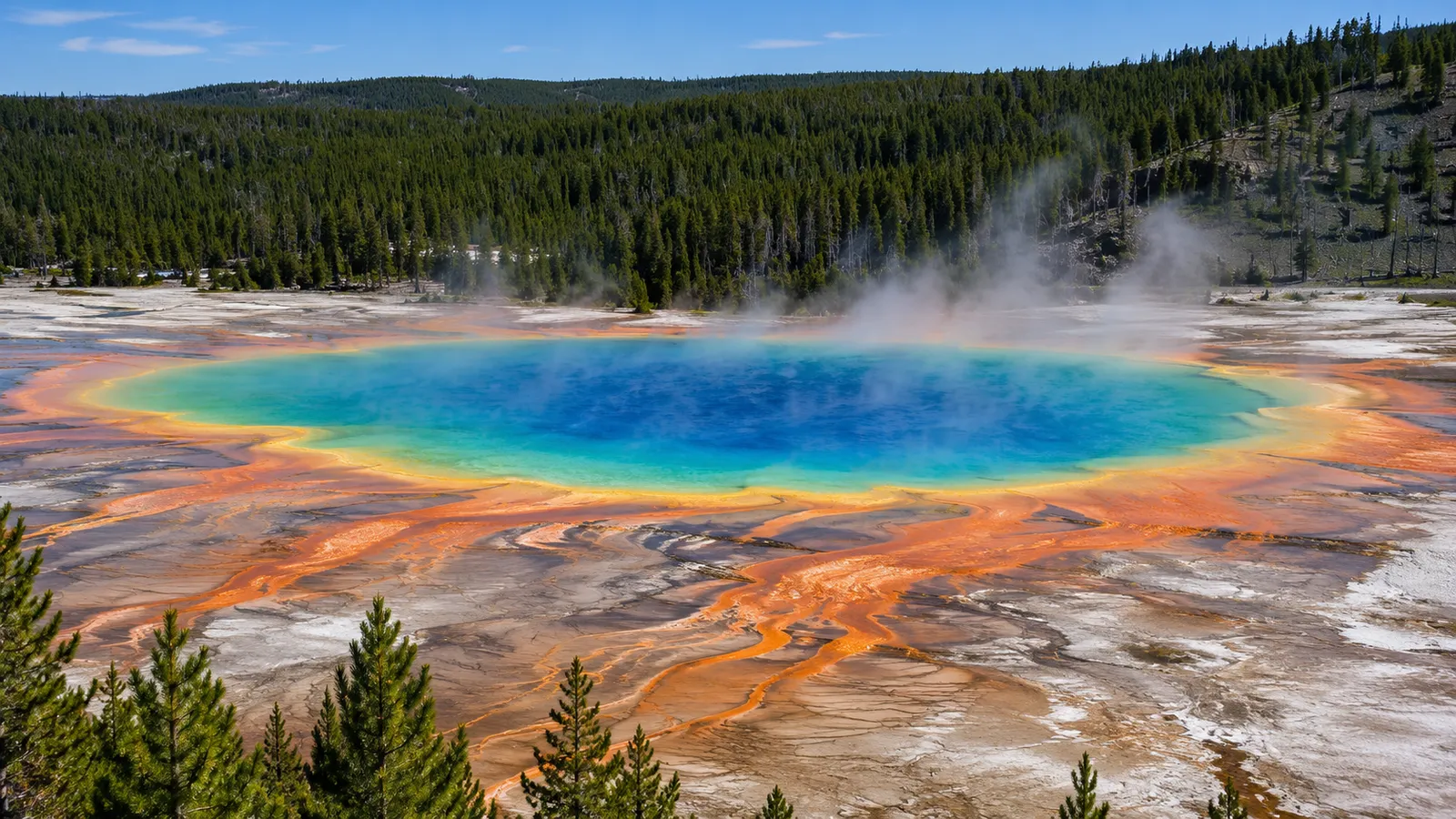
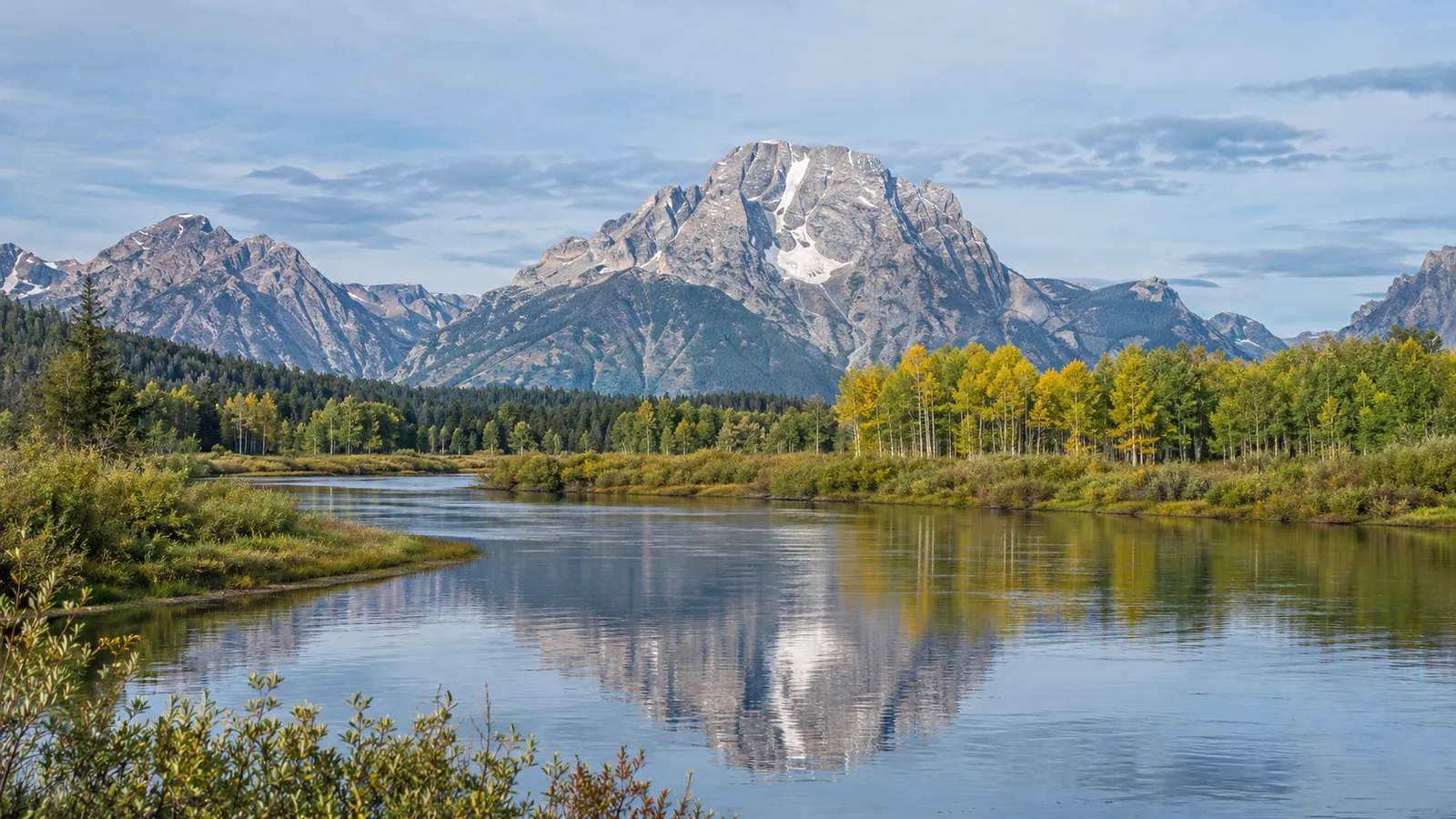
The blue of Grand Prismatic fades into turquoise, then meets orange margins spreading across the pale crust. Further south, a lake in front of the Tetons may reflect the mountains’ outline; in Lamar Valley, small dark dots become bison through binoculars. A week in Yellowstone and Grand Teton brings together these three scales: the detail of a spring, the breadth of a valley and a rock face rising above the water.
We suggest seven days and six nights, arriving and departing through Jackson Hole Airport, in the valley below the Tetons; Jackson is the town where we propose staying. Spend the first two nights here, then enter Yellowstone from the south and travel through thermal basins and the northern sector before returning to the Tetons. This loop is for the season when the necessary roads and services are open. Choose walks, wildlife watching and river activities according to your interests, conditions and flight times.
Two neighbouring parks, two stories of the Earth
The Tetons rise sharply above Jackson Hole. Movement along a fault, a fracture in the Earth’s crust where blocks of rock shift, helped lift the range relative to the valley. Glaciers later widened canyons and carved hollows now occupied by lakes. The geology of Grand Teton helps explain this landscape: ancient rocks, with landforms shaped by much more recent processes. Looking from a lakeshore reveals their shape without climbing to higher ground.
At Yellowstone, volcanic heat and groundwater feed different phenomena. A hot spring allows water to circulate; a geyser builds pressure and releases jets of water and steam. Hydrothermal features, associated with water heated underground, also include mudpots, fumaroles — openings releasing steam — and terraces of travertine, rock deposited by water rich in calcium carbonate. A thermal basin is an area where these features cluster: walking its boardwalks means noticing differences in movement, colour and deposits.
Five stops, six nights
1. Jackson · Grand Teton2 nights
Separate arrival from a day devoted to lakes, views and a chosen walk.
2. West Yellowstone1 night
Sleep near the western entrance after visiting the Old Faithful area.
3. Canyon Village1 night
Stay in the central sector for the Yellowstone canyon and Hayden Valley.
4. Gardiner1 night
Finish the northern sector with Mammoth and a visit to Lamar Valley.
5. Return to Jackson1 night
Keep the final overnight stop near the airport after returning through the parks.
A week to meet these places, longer to linger
This proposal allows one full day for the Tetons, three travelling through Yellowstone’s main sectors and one for the return, alongside arrival and departure. It is a first exploration with several changes of base: reduce sightseeing on transfer days rather than pursuing every point on the map. With nine days, we add a night in the Tetons and one in central Yellowstone, making room for a longer walk or another wildlife-watching session. With five days, we choose one park, or two clearly defined sectors, and redraw the loop. The door-to-door duration depends on flight connections and may require extra nights.
Grand Teton: lakes and trails beneath the peaks
The first full day focuses on Jenny Lake, at the foot of the Teton Range. From the eastern shore, mountains rise beyond the water and the view opens into Cascade Canyon. For a gentle introduction, stay near the shore, also accessible along the short, paved Discovery Trail. For a woodland walk, Hidden Falls is a waterfall fed by snowmelt; higher up, Inspiration Point is the viewpoint overlooking the lake and Jackson Hole valley.
The boat crosses the lake and shortens the approach, but you still walk after disembarking. From the western dock, allow about 1.6 km return to Hidden Falls and about 3 km to Inspiration Point, with roughly 170 metres of ascent: the final section has rock steps, roots and steep switchbacks. The park suggests two–four hours for the latter walk. Without the boat, the route along the southern shore to Inspiration Point becomes a moderate walk of around 9 km return and 270 metres of ascent. You can also stop at the waterfall and turn back. The shuttle is optional and these trails do not require a guide: choose according to time, energy and conditions.
The Jenny Lake Boating shuttle does not take bookings: buy tickets at the dock and board as the service allows. When checked in November 2026, the published adult fare for ages 13–61 was USD 20 return. Timetables are seasonal; the page still shows the 2026 season, so for a 2027 departure you need to wait for or check the relevant calendar. If you want to return by boat, the last crossing becomes a real constraint on your walk.
Oxbow Bend is a bend in the Snake River with a viewing area near the road: you can see Mount Moran above the river without a long hike. Morning light may highlight the mountain; wind and current determine how much of its reflection appears. It is an alternative to a second walk on your Jenny Lake day. For sunset, choose somewhere that does not greatly extend the drive back: wildlife makes it sensible to minimise driving after dark.
Old Faithful and Grand Prismatic: making the wait worthwhile
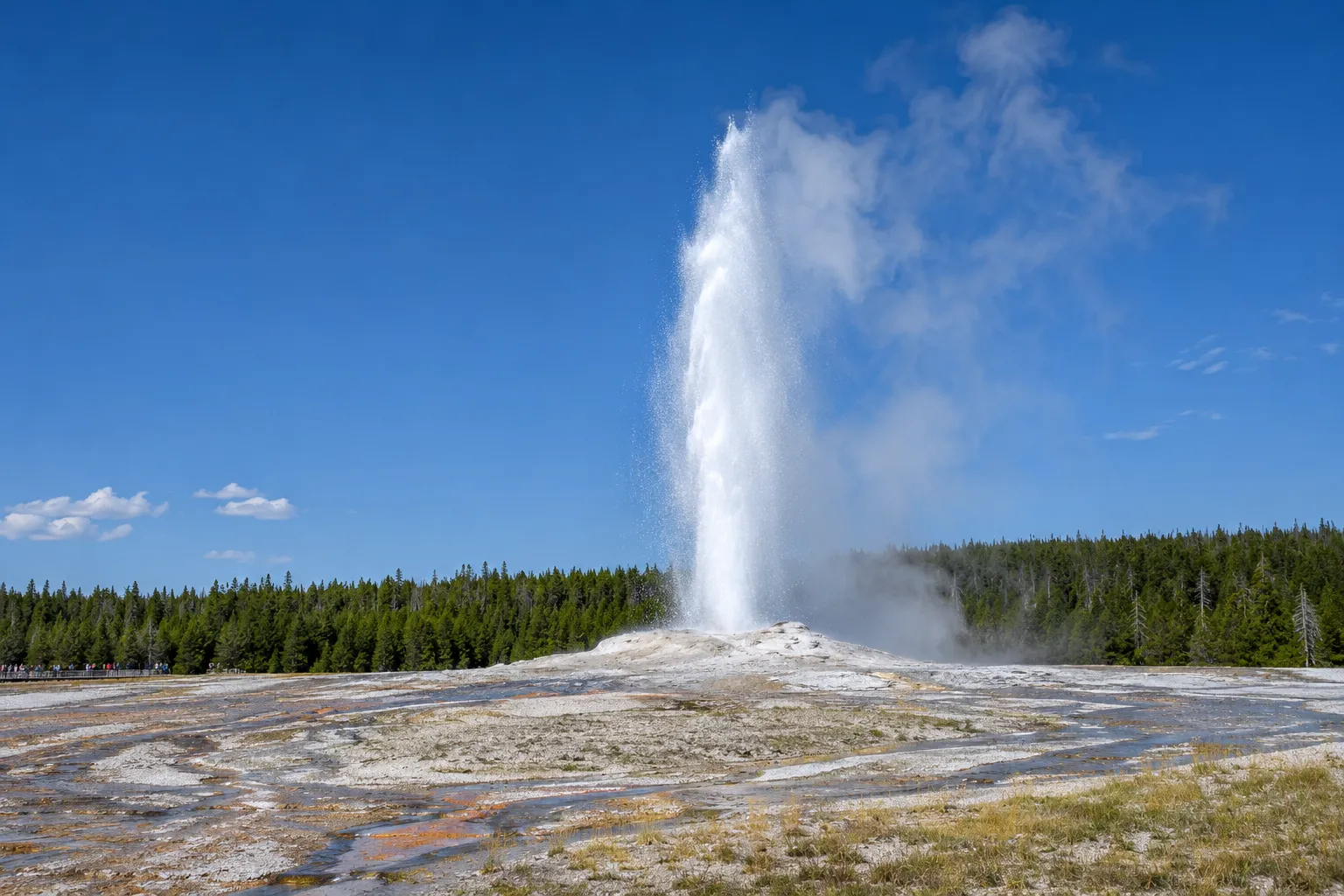
Entering Yellowstone from the south, West Thumb offers a compact introduction: colourful springs and mineral deposits beside Yellowstone Lake, with open water beyond. The main boardwalk loop is about 1 km; the park suggests 30–60 minutes and rates it easy. Further on, Upper Geyser Basin is an extensive area of geysers and springs to explore on foot. Its best-known attraction is Old Faithful, a geyser sending up a column of water and steam visible from the designated viewing area. Follow the rangers’ updated prediction: it is a window for a natural phenomenon, not a fixed appointment every ninety minutes.
Grand Prismatic is the large spring recognisable by its blue centre and colourful edges, home to microorganisms adapted to different conditions. The Midway Geyser Basin boardwalks bring you close to steam, water and runoff, but from that level you cannot see the spring’s full pattern. For a view from above, choose the Grand Prismatic Overlook, starting at the Fairy Falls car park: around 1.9 km return, 32 metres of ascent and one–two hours according to the park, which rates it easy. Reaching the overlook does not mean reaching Fairy Falls waterfall, further away. Choose one visit or both according to openings, visibility and energy; steam can obscure part of the basin.
The Yellowstone canyon: water takes centre stage again
On the day towards Canyon Village, we choose a thermal basin in the morning and the canyon in the afternoon. Grand Prismatic is especially interesting for the pattern and colours of its large spring; Norris for its mix of springs, bursts of steam and mineral landscapes. Porcelain Basin is more open and almost treeless, with a loop of around 1.2 km; Back Basin goes further into woodland, with around 2.4 km. There are boardwalks, earth paths and steep approaches: sections differ in accessibility and effort. You might choose Norris instead of an in-depth Grand Prismatic visit, or save it for a longer stay. Sleeping in the central sector avoids an evening drive back to the park’s western entrance.
The Grand Canyon of the Yellowstone is the gorge carved by the Yellowstone River, distinct from Arizona’s Grand Canyon. Lower Falls plunges between yellow, orange and red walls, whose colours partly result from hot water altering volcanic rocks. Artist Point offers an overall view of the waterfall framed by the gorge, reached by a short path from the car park. It is a good first choice for seeing the landscape without a long descent.
The Brink of the Lower Falls offers a different experience: descend to where the water spills over the waterfall’s edge and feel its force and sound at close quarters. The return distance is around 1.1 km, but with approximately 180 metres of elevation to climb back up: short does not mean easy. The trail is very steep and is subject to closures for snow and ice. Choose Artist Point for a panorama with less effort; consider the Brink only if you can manage the return climb and the path is open.
Lamar and Hayden: watching without deciding what happens
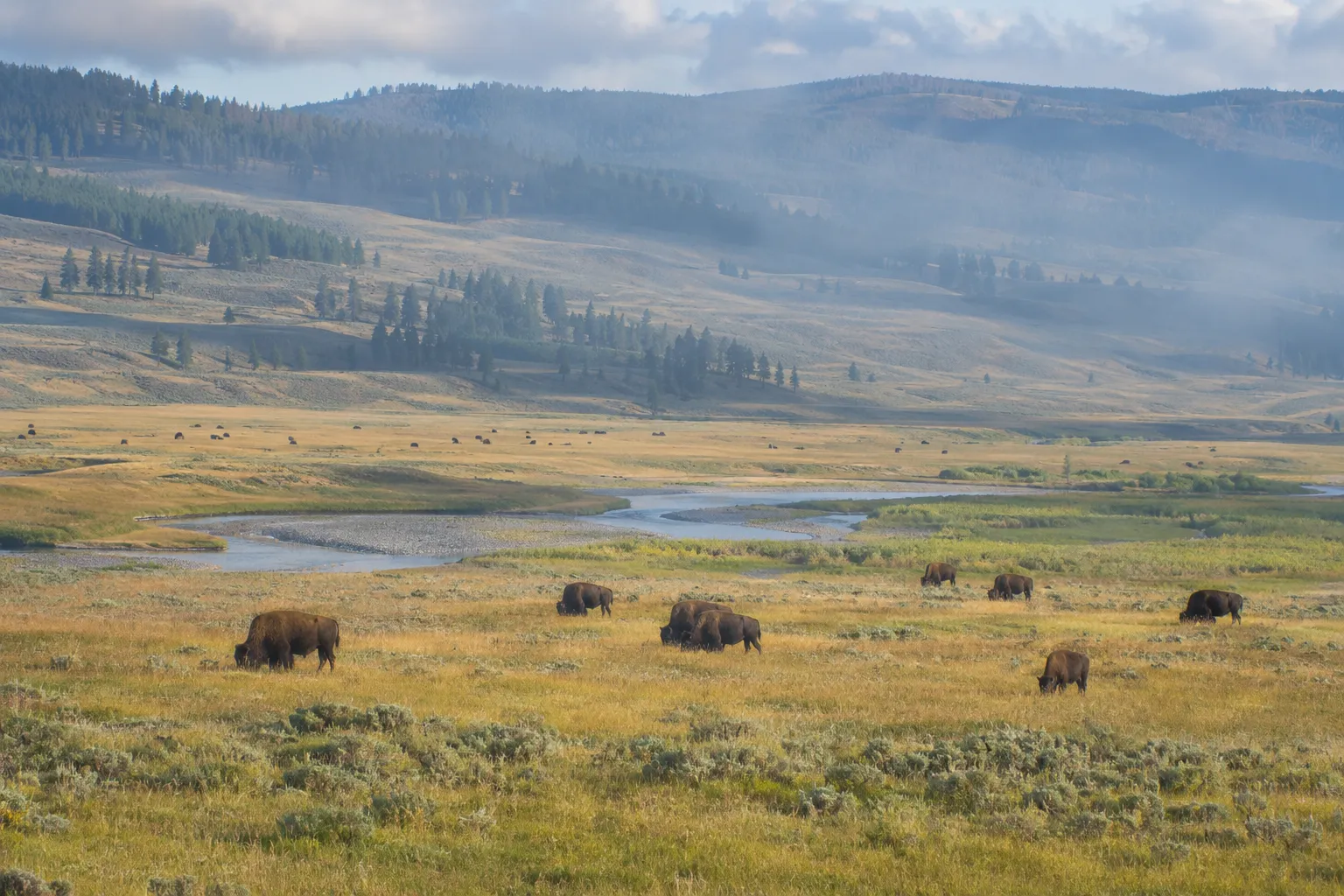
Hayden Valley lies in central Yellowstone, south of Canyon Village, along the river: its grasslands fit into a canyon visit. Lamar Valley is in the north-east and requires a dedicated detour, to combine with the northern stop. Both offer open spaces for watching bison and other animals from permitted pullouts. Wolves and bears may be distant or absent; wapiti, called elk in the United States, are large deer, distinct from moose.
You can watch wildlife independently from permitted areas, with binoculars and patience: booking a tour is not compulsory. A guide in Lamar Valley can help you understand animal movements and use a spotting scope for distant subjects. This is especially useful if wildlife is central to your trip; no outing guarantees sightings. Choose a valley to spend time in rather than crossing both merely looking for the next species.
If you book a dawn outing in Lamar Valley, agree on a meeting point compatible with your base and assess the drive from Canyon Village beforehand. Towards Gardiner, visit Mammoth Hot Springs: pale stepped terraces made of travertine deposited by the water. Flows shift and can leave areas dry. A long wildlife-watching session means reducing the rest of the day’s programme; Mammoth also deserves time to stop, rather than just a passing photograph.
Yellowstone’s rules require at least 100 yards, about 91 metres, from bears, wolves and cougars, and at least 25 yards, about 23 metres, from other animals, including bison and elk. Move away if an animal approaches, and increase your distance whenever your presence changes its behaviour. Use permitted pullouts without stopping in a traffic lane; do not leave food unattended. For hikes, also prepare the equipment and precautions for visiting bear country, including bear spray as advised by the park.
Bases: moving your overnight stops with the journey
Jackson has services and access to the southern sector; two initial nights avoid tackling Yellowstone straight after your flight. West Yellowstone is an external base for the geyser sector, but entering and driving take time: it is not accommodation beside every basin. Canyon Village reduces some backtracking in the central sector; Gardiner fits the northern visit. That means three consecutive nights in different bases, a choice to accept before booking. If you prefer fewer moves, spend more nights in one area and visit fewer sectors. Accommodation inside the park has its own seasons: check service opening dates, then the operator’s availability. If Canyon Village is unavailable, rebuild the programme rather than swapping its name for a distant base and keeping the same timings.
A history older than the park
The law establishing Yellowstone was signed on 1 March 1872. That date concerns a US institution; documented human presence in the region goes back more than eleven thousand years. Indigenous communities hunted, gathered plants, quarried obsidian and maintained spiritual relationships with the land. Today the Tribal Heritage Center hosts artists, scholars and representatives of the nations associated with the park, according to its seasonal programme. A visit offers a chance to hear these voices in the present, alongside the stories of geysers and wildlife.
What we leave out to make time for the stops
These are exclusions from this proposal, to change if one of these places is your main reason for travelling.
They need their own days, preparation and conditions: in seven days we prioritise shorter encounters with different environments.Long hikes at altitude
It takes the trip much further north and requires a different itinerary and additional overnight stops.An extension to Glacier National Park
We choose a few basins and leave room for the canyon and wildlife; collecting them all would take time away from observation.Exploring every thermal basin in depth
The season and the return journey
This route is designed for late June to early September, when combining roads, accommodation and seasonal activities is generally simpler; every opening still needs checking. July and August mean managing demand and traffic. Early September can offer a good balance, but services begin operating shorter schedules and cold mornings matter. Yellowstone’s weather can bring snow in any month: a warm jacket and layers belong in your luggage even between June and August.
When checked in November 2026, most roads were closed to ordinary vehicle traffic for winter, so this loop was not immediately driveable. In the winter months, December–February, the park offers other experiences with different access and transport. For a future departure, consult the NPS road map and calendars, without automatically transferring one year’s dates to the next.
Returning from Gardiner to Jackson crosses a substantial part of the area: devote the day to the transfer, with a few selected stops, and sleep in Jackson. The scenic float trip on the Snake River suggested in the itinerary offers views of the river and mountains from the water and is an optional organised activity. On flight day, choose it only if meeting time, duration and airport margin fit; otherwise skip it or add a night to give it time.
A budget built around your bookings
For orientation, we compare two spending examples of around USD 2,000–3,000 per person, for seven days and six nights, with two adults sharing a room and car. These are simulations using chosen planning allowances, not a range of observed prices or a prediction of your costs. Flights and travel insurance are excluded. The first allows USD 260 per room per night, USD 500 per person for meals throughout the week and USD 490 for the car in total; the second raises these amounts to USD 360, USD 700 and USD 690. Each pair of amounts in the table follows this order. Quotes for your dates may be higher: accommodation location, availability between June and August and hire conditions substantially change the result.
When checked in November 2026, the annual NPS pass for non-US residents cost USD 250, covering occupants of a private vehicle under the pass rules, including nonresident surcharges at the parks concerned. We therefore divide it into two shares of USD 125. It does not cover accommodation, tours or boats. For two adults visiting both parks, compare this cost with separate entry fees and recheck the rules for your year of travel.
Two examples compared: amounts per person
Rounded example totals; flights and insurance excludedAround USD 2,000–3,000
Food spending depends on included breakfasts, supermarket shopping, picnics and restaurants. The table’s allowances are personal planning choices: tax, tips and drinks can change what you need, and no daily figure guarantees what you will spend.
Before booking, replace assumptions with the actual full quotes: rooms including tax and supplements, a car with insurance cover and contractual charges, activities with fees. A private wildlife guide or river outing may alone exceed the activities allowance: if you choose one, add its quote to your calculation. The reserve cannot accommodate every comfort choice, and USD 3,000 is not a guaranteed ceiling.
The week still makes sense with one less boat trip and a whole afternoon looking at the same valley. The moment you remember may be the one when you stopped looking for the next stop.
The day by day, ready to use: it’s in Explore.
7 days and 36 places on the map, with times and travel. Open it, import it into your trips and change it as you like.
5 stages · 6 nights
Liked an article? Make it your trip
Plan the days, the places and the budget with Daysaway, on the map, with the help of the assistant.