Central Australia: land, stories and the peoples who keep them
At Uluṟu, the journey begins before a rock and continues through ancestral stories, land reclaimed and artists passing on to their children what they learnt from their grandparents.
In 30 seconds
- Uluṟu is a good starting point for getting to know Central Australia’s Aboriginal cultures, with their different languages, lands and traditions.
- Colonisation took land and separated families; the struggle to regain it led to Uluṟu’s handback in 1985.
- On the journey, we make time for the Cultural Centre, activities with Aboriginal organisations and artist-run galleries.
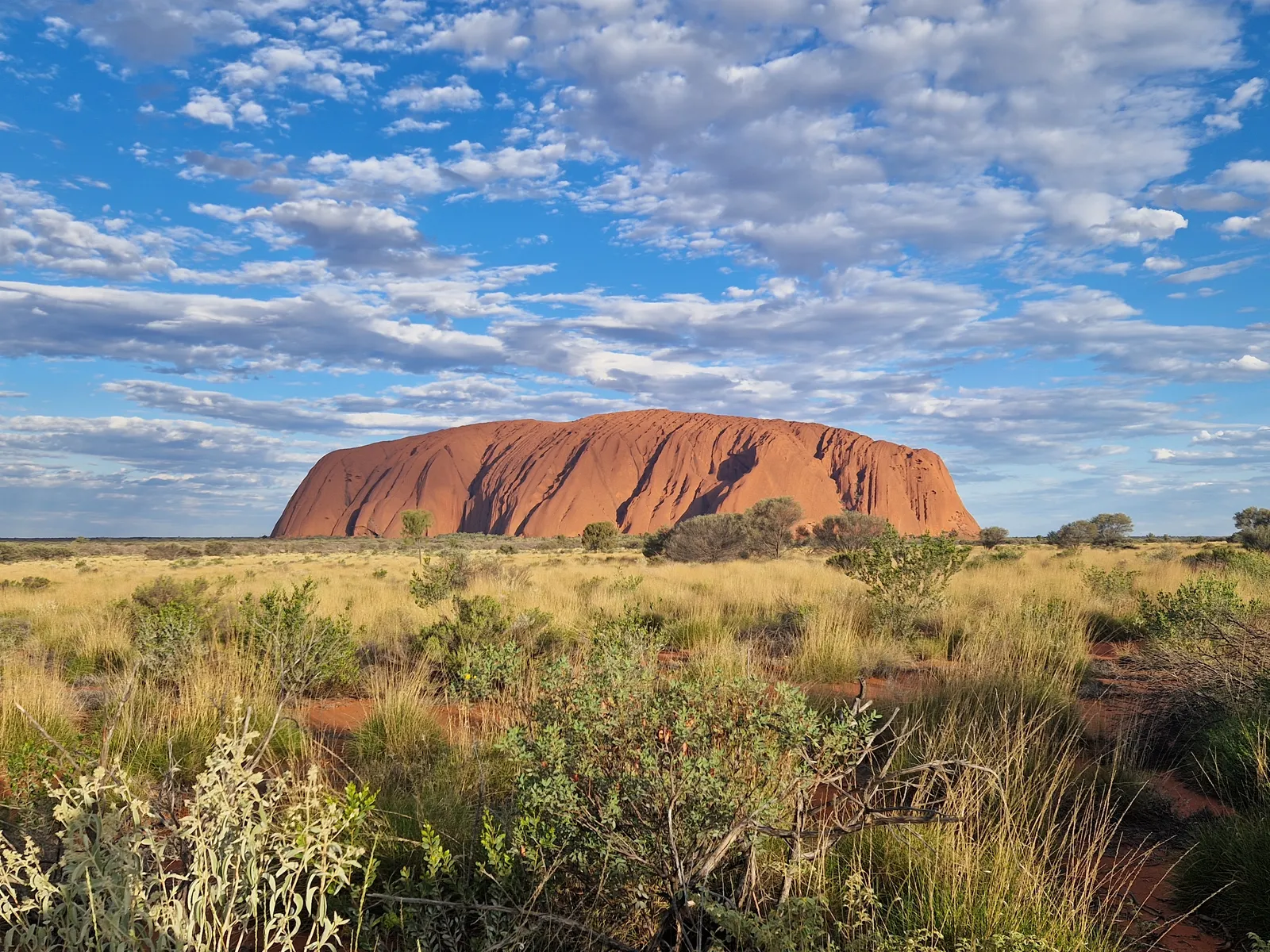
Red sand shows between clumps of pale grass; behind the shrubs, Uluṟu fills the horizon. From a distance its surface seems solid and unbroken. Come closer and folds, hollows and traces of water emerge. For the people who live here, these details have names and stories learnt while growing up. A visit can begin with this: pausing at the foot of the rock and listening to the people who have known it for generations.
The stories that accompany Uluṟu
The Traditional Owners of Uluṟu and the nearby rock domes of Kata Tjuṯa ask to be called Aṉangu. These lands belong to their Aboriginal communities. Their connections with the land continue through families, teaching and decisions about the park. Their own introduction.
At the heart of Aṉangu culture is Tjukurpa: the knowledge, ancestral stories and laws that guide relationships between people, land and living beings. It encompasses spirituality and everyday life, from responsibility for a place to behaviour towards others. Stories of ancestral beings explain how the landscape formed; they can also teach how to reach a waterhole, where to find food and when to look for it. A story can accompany a route and help people find their way in the desert. Knowledge deepens throughout life through teaching, songs and ceremonies. Tjukurpa explained by Aṉangu.
This connection helps explain the word Country, which you will often encounter in cultural centres. For many First Peoples it embraces the land and relationships with ancestors, animals, plants and water. Caring for Country is part of belonging to it. Meanings vary between communities: Australia is home to many Aboriginal cultures, each with its own languages and traditions. Common Ground explores this relationship with the land.
When the colonisers arrived
Colonial expansion imposed a different way of occupying land on a society built around these connections. British colonisation began on the east coast in 1788; it reached the centre of the continent later, with missionaries, prospectors, officials and pastoralists. In the 1870s, cattle began consuming food resources and contaminating waterholes on which communities depended. Losing access to water meant losing the ability to stay. Aboriginal resistance was met with armed repression, while introduced diseases compounded the consequences of occupation. The Central Land Council’s account.
The telegraph station established at Alice Springs in 1872 makes this transformation tangible: settlements and cattle stations grew around permanent water sources, taking land from its original inhabitants. Tangentyere traces this history. Violence continued after Australian federation in 1901. In 1928, the massacres known as Coniston killed men, women and children in the interior; their families keep their memory alive today. The descendants’ remembrance.
Control extended into family life. Aboriginal and Torres Strait Islander children were removed from their families under laws and policies of forced separation: they are the Stolen Generations. The Bringing Them Home inquiry, published in 1997, gathered testimonies and documented consequences still felt by families. Loss of land became intertwined with the breaking of relationships through which language and knowledge were passed on. The Australian Human Rights Commission’s report.
Owning their land again
The demand to return to ancestral lands drove decades of campaigning. The Aboriginal Land Rights Act 1976, covering land rights in the Northern Territory, enabled recognition of Aboriginal ownership and further claims. The Central Land Council, a representative body for Central Australian communities, was established during this struggle. The history of the movement.
For Uluṟu, recognition came on 26 October 1985: title deeds were handed back to Aṉangu, who leased the park for 99 years for joint management. The board has an Aṉangu majority. After years of being discouraged from visiting parts of their own lands, the Traditional Owners could once again decide their future. The handback as told by the National Museum of Australia.
The closure of the climb on 26 October 2019 is part of this history too. Aṉangu had long asked visitors not to take a route of cultural importance to them. Today, visits continue along the paths at the base and in the Cultural Centre. How the closure came about. Caring for the land also includes the work of Aboriginal rangers: their use of fire combines inherited knowledge with contemporary tools to protect people, sites and vegetation. Work on Country.
Alice Springs: language, homes and painting
Continuing towards Alice Springs, we enter another people’s Country, that of the Arrernte. Mparntwe is the city’s name in the local language. Here, the story of land continues in the Town Camps, Aboriginal residential neighbourhoods whose residents organised to secure housing, water and services. Tangentyere Council grew out of this movement: its name means “working together”. The organisation’s history.
In its gallery, Tangentyere Artists, paintings tell of families, identity and daily life in the neighbourhoods. Intense colours, figurative scenes and animations bring urban life into the story too. The centre is Aboriginal-owned and welcomes artists from different backgrounds: spending time with the works reveals different experiences, without assuming every artist paints in the same way. Tangentyere’s artists and works.
Painting with grandparents
North-west of Alice Springs, in the communities of Yuendumu and Nyirripi, many artists are Warlpiri, another people of Central Australia. Warlukurlangu Artists, founded in 1985 and owned by its artists, describes a particularly lovely scene: grandparents and grandchildren painting together, while Elders may sing the stories connected with a work. Painting becomes a way of teaching and working in the same place.
In the Warlpiri language, Jukurrpa refers to knowledge and ancestral stories connected with people and lands. The term belongs to this culture, distinct from the Aṉangu culture encountered at Uluṟu. Each artist chooses colours, forms and parts of a story to share. In the gallery, we can ask where a painting comes from and listen to its story; some knowledge remains reserved for those entitled to hold it. Warlukurlangu Artists.
Encounters to seek on the journey
At Uluṟu we begin at the park’s Cultural Centre: the park recommends at least two hours for exhibitions and galleries. For an artistic experience, Maruku Arts, an Aṉangu organisation, offers workshops in Yulara, the visitor hub near the park. The ranger-guided Mala Walk offers a guided walk at the base of the rock; a ranger activity and an encounter with an Aboriginal organisation are led in different ways.
| Where | What to look for | Before you go |
|---|---|---|
| Uluṟu Cultural Centre | Exhibitions, galleries and context for the walks. | Allow at least two hours; a park pass is required. |
| Maruku Arts, Uluṟu/Yulara | Gallery and workshops run by an Aṉangu organisation. | Book your chosen workshop directly. |
| Tangentyere Artists, Alice Springs | Contemporary painting and stories of urban life. | Contact the gallery; the Town Camps are residential areas. |
| Warlukurlangu Artists, Yuendumu | An artist-owned art centre. | About 290 km from Alice Springs: arrange the visit and check the road. |
Visiting Warlukurlangu in Yuendumu requires careful travel arrangements: cultural and seasonal needs can affect opening, and rain can affect the Tanami Road. Contact the centre before setting out.
Our eight-day Red Centre itinerary, from Alice Springs to Uluṟu, makes time for art centres, the Cultural Centre and a workshop with Maruku Arts, alongside walks and desert landscapes. A visit to Warlukurlangu in Yuendumu remains among the ideas to arrange separately.
Red Centre in 8 days: Aboriginal art, stories and Country from Alice Springs to Uluṟu: it’s in Explore.
8 days on the map, to import into your trips.
Frequent questions
Does Aṉangu mean all Australian Aboriginal peoples?
No. At Uluṟu, the Pitjantjatjara and Yankunytjatjara Traditional Owners ask people to use Aṉangu. Elsewhere, peoples, languages and names differ: follow local guidance.
Do you need a permit to visit a community?
It depends on the road, place and activity. Do not apply a gallery’s rules to other lands or homes: consult the Central Land Council’s permits and arrange the visit.
Why are some stories not explained in full?
The passing on of knowledge may depend on age, roles and family connections. Artists and guides choose what they can share; understanding this boundary is part of the visit.
Liked an article? Make it your trip
Plan the days, the places and the budget with Daysaway, on the map, with the help of the assistant.