Oktoberfest: see you at the Wiesn
From royal wedding celebrations to today’s shared tables: music, food, traditional dress and games, with our memories of 2022 and practical information for the 2027 Wiesn.
In this guide
- In 30 seconds
- A wedding celebration that became a city within the city
- Inside the tents: choosing an atmosphere
- Reservations: the table, the time slot and the vouchers
- Brezn, roast dishes and a break from the beer
- Cash, traditional dress and an unexpected curiosity
- Bring home a stein, leave time for Munich
- Frequent questions
In 30 seconds
- The next Oktoberfest takes place in Munich from 18 September to 3 October 2027, on the Theresienwiese.
- Entry to the main grounds and tents is free; a table reservation normally involves food and drink vouchers. The Oide Wiesn has separate admission.
- Beyond the beer: music, Bavarian food, rides and fairground games. Bring cash: cards are not accepted everywhere.
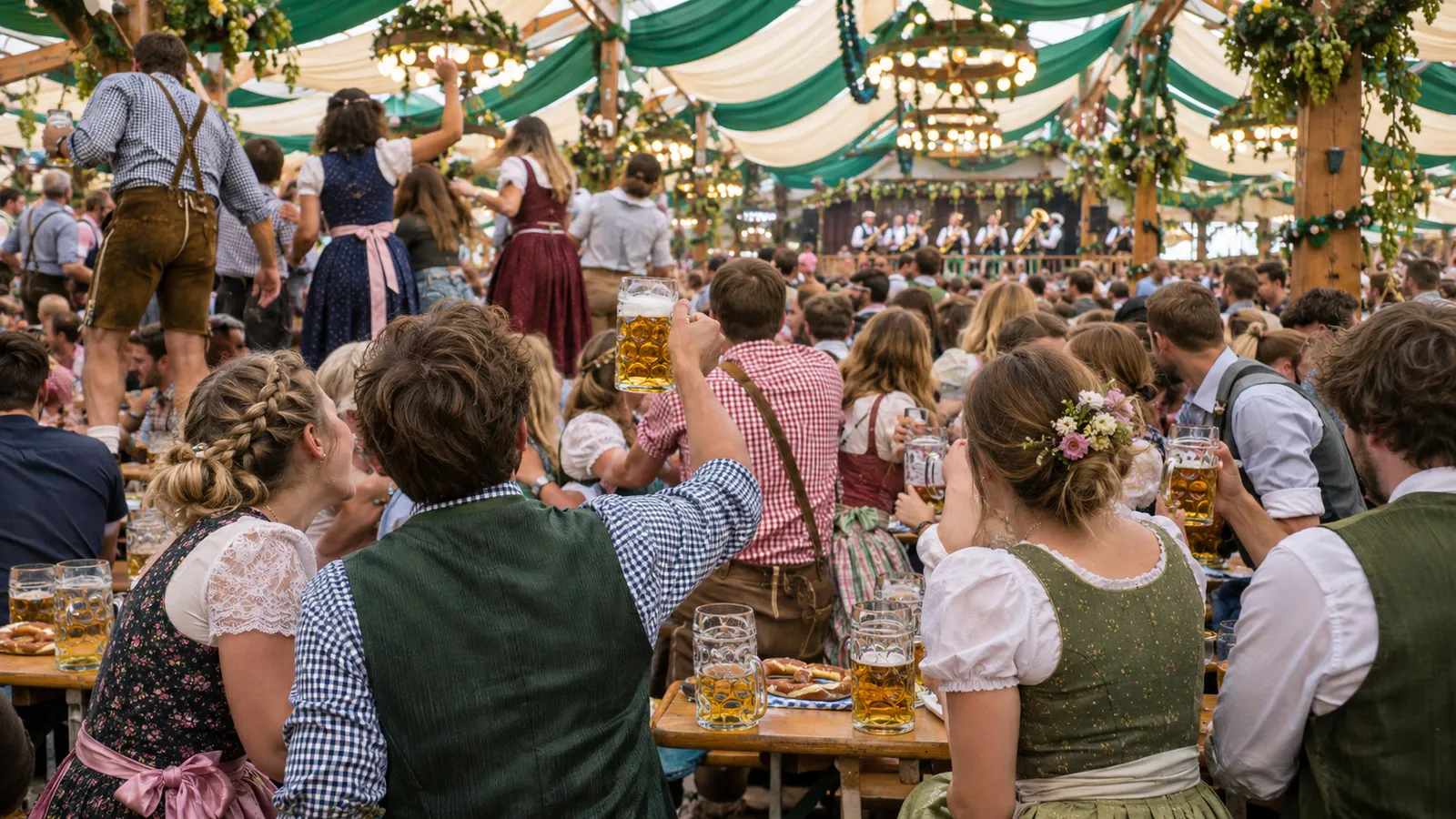
A stein recalls one particular year; memories of a festival also live in the games, the clothes and the time spent together. We visited Oktoberfest over the weekend of 1–2 October 2022: fun days of celebration and sharing that left us wanting to return. We also loved the traditional outfits, which we would like to wear ourselves next time. Those memories are our starting point, alongside the history of the Wiesn and official information for planning another trip.
A wedding celebration that became a city within the city
It did not begin with a gigantic beer tent. On 12 October 1810, Crown Prince Ludwig married Therese of Saxe-Hildburghausen; on 17 October, a horse race celebrated the wedding outside the city. The meadow took the bride’s name: Theresienwiese, shortened in Bavarian to Wiesn. Repeated celebrations, an agricultural fair and later municipal organisation helped turn it into a regular event. The official history puts today’s festival in context: a civic celebration shaped by generations of innkeepers, brewers and fairground families.
The dates moved towards September to take advantage of milder conditions; the name remained. The official dates for 2027 are 18 September–3 October. The opening ritual takes place at noon on the first Saturday, when the first barrel is tapped at the Schottenhamel. The traditional costume and marksmen’s parade is scheduled for 19 September: bands, associations and floats reveal more of Bavaria than its beer alone.
Inside the tents: choosing an atmosphere
Long shared tables bring people together, but the tents have different characters. Blasmusik, the music of wind bands, sits alongside more exuberant repertoires: the mood changes with the venue and the hour. To choose, we compare the official profiles of the large tents, rather than simply following the most famous name.
| Tent or area | What makes it distinctive | Who it might suit |
|---|---|---|
| Augustiner-Festhalle | Beer traditionally served from wooden barrels, with brass-band music. | Visitors who want to start with a large tent rooted in the city’s brewing culture. |
| Hacker-Festzelt | A ceiling painted like a Bavarian sky and a large, lively hall. | Anyone looking for a distinctive setting and a festive atmosphere. |
| Festzelt Tradition, Oide Wiesn | Folk music, dancing and associations in traditional costume. | Visitors interested in traditions; the area has separate admission. |
| Small tents | Food specialities and more intimate spaces, with different programmes. | Anyone choosing around lunch as well as music, and comparing menus and settings. |
The Oide Wiesn, in the southern section, began with the bicentenary in 2010. Historic rides and traditional dancing offer a different rhythm to the festival. At the Festzelt Tradition, associations keep repertoires and dances alive: Schuhplattler, with rhythmic slaps on shoes and thighs, is a practice performed and passed on, as well as something visitors can watch.
Reservations: the table, the time slot and the vouchers
There is no single central reservations office: contact the tent’s operator through the links on the official website. The reservation itself is free, but normally requires buying food and drink vouchers in advance. Reservations are often for a table rather than an individual seat, and for a specific time slot. Before paying, check the number of guests, included food and drinks, deadlines and conditions for your booking.
Some seats remain unreserved: you can walk in and look for space, but a full tent may temporarily close its entrances. For a group hoping to stay together, arriving early on a weekday gives more flexibility than turning up on Saturday evening. The crowd barometer helps with planning; moving to another tent in the afternoon does not guarantee finding a table straight away.
Brezn, roast dishes and a break from the beer
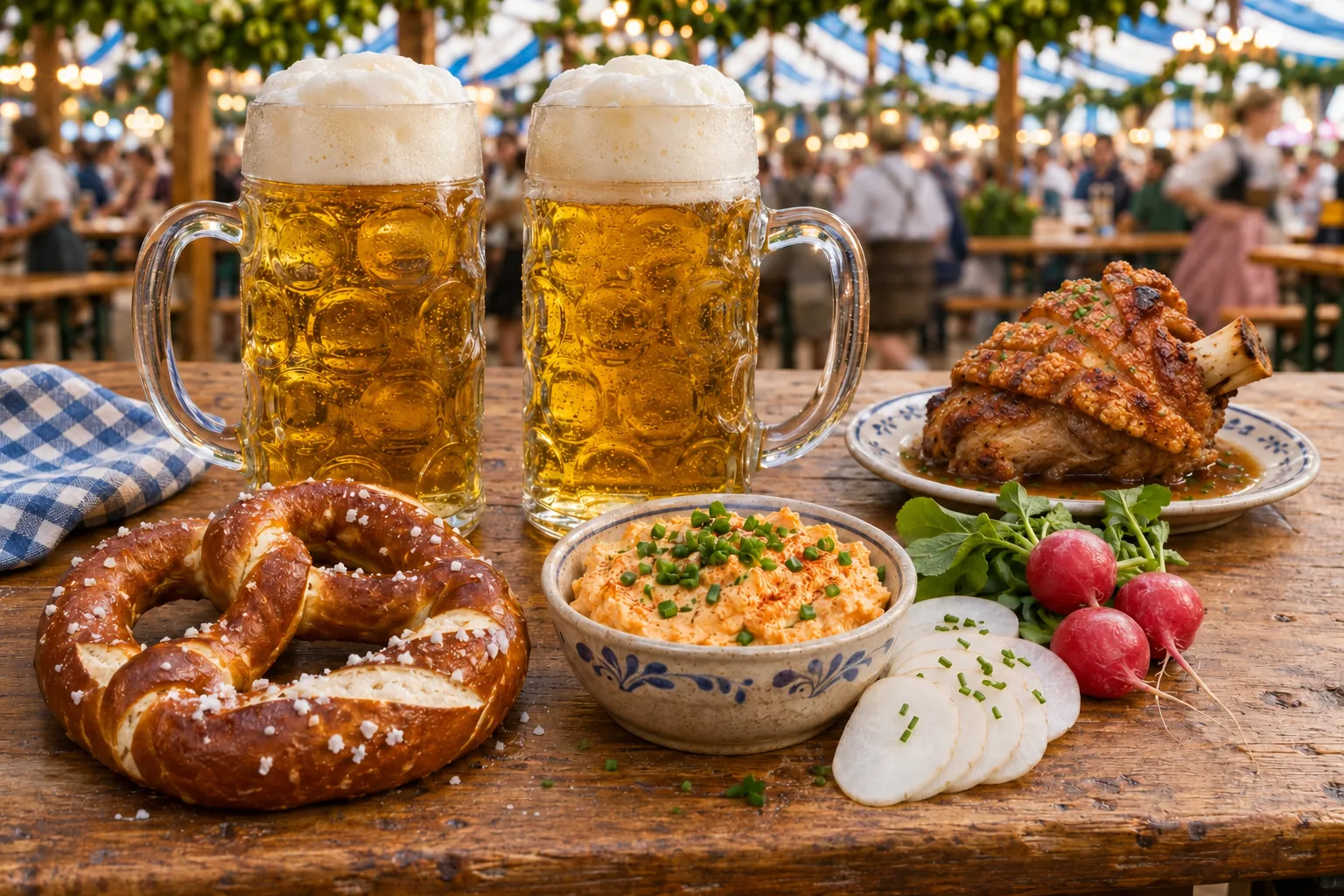
One of the dishes we ate that weekend was roast pork knuckle, or Schweinshaxe. It is one of the Bavarian specialities to look for on festival menus, alongside Hendl, roast chicken. A Brezn, the Bavarian name for a Brezel, is the large twisted bread with a salty crust. For sharing, there is Obatzda, a seasoned cheese spread, and Radi, radish. Vegetarian and vegan menus also include Käsespätzle, egg noodles with cheese, and various dumpling and mushroom dishes: a meat-free dish is not necessarily vegan, so check the menu of the particular tent.
We also enjoyed the attractions and fairground stalls where you could challenge one another, such as the high striker hammer game and shooting galleries. Spending part of the day at the fairground lets you experience the festival away from the tables. The same goes for anyone who does not drink alcohol: food, music and rides can easily fill a visit.
Cash, traditional dress and an unexpected curiosity
In 2022, the reliance on cash surprised us and felt a little inconvenient. It has not disappeared: the official FAQs still list cash-only tents, including Augustiner and Bräurosl; elsewhere cards are accepted, with differences between payment networks. There is no single official explanation that applies to every business. The practical approach is to carry some cash and check the accepted payment method before ordering, without assuming every foreign card will work.
Dirndls have not remained unchanged for centuries: their history connects rural work clothes with later reinterpretations in fashion. Lederhosen have also moved through workwear, the revival of traditions and festive use. Reading the history of the Dirndl adds interest to choosing an outfit; wearing one remains optional.
Bring home a stein, leave time for Munich
We brought a stein home, with an illustration that changes from year to year. There is also an official series: the Oktoberfest ceramic stein features the annual poster. It is a way to remember a particular edition without turning the trip into a race to drink more.
For a weekend, we suggest one day at the Wiesn and one in Munich, leaving room between visits and reservations. U4/U5 serve Theresienwiese; U3/U6 at Goetheplatz or Poccistraße are alternatives for the southern section. The city’s guide to the Oide Wiesn explains the access points: choosing the right station avoids unnecessary walks across the grounds.
Frequent questions
Does a table reservation last all day?
It normally covers a time slot with fixed hours. The operator’s confirmation tells you when to arrive and when to leave the table; it is not an unlimited stay.
Are all the prices for 2027 available yet?
At our November 2026 check, not all price lists for the next edition were available. Beer, menu and reservation prices from 2026 should not automatically be carried over to 2027.
Can we go back into a tent after leaving?
Do not count on getting straight back in: if entrances close because of crowding, having found a seat earlier does not guarantee re-entry. For reserved tables, the operator’s stated conditions apply.
Christmas markets of Bavaria and Saxony in 6 days: Munich, Nuremberg and Dresden: it’s in Explore.
A Daysaway team itinerary, to import into your trips: 6 days, 41 places on the map.


Liked an article? Make it your trip
Plan the days, the places and the budget with Daysaway, on the map, with the help of the assistant.